Showing posts with label send. Show all posts

Thursday, March 29, 2012

This One's For the Bobcat

I found myself more centered last weekend at the New River Gorge than I was on my prior outing.  I was rested, and not so thirsting for beer as I am sometimes at the end of the week.  I felt simply glad to climb--not overly eager, and fretting over details.  This would be a good weekend.

Saturday morning at Endless Wall, Alex won our customary rock flip and started us on Discombobulated.  Apart from fingery holds at the second and third bolt, the difficulties were punctuated enough for the route to serve as a decent warm up.

Next came Aesthetica.  I was pleased with my flow, and lack of hesitation on the aesthetic long moves, but it wasn't enough to win the onsight.  I took a fall at the crux.  Then, high stepping to a two-finger pocket, I skipped the big hueco out left, and climbed the second half to the chains.  Alex flashed the route.

Winning the second rock flip, for Mig Squadron, Alex racked and hiked the starting layback flake to a good stance preceding a blank traverse.  He inspected the diminutive holds, committed, toes smedging on glints in the sandstone, but ultimately fell in a slight pendulum.  Second try, he negotiated the thin part to an awkward stance, high stepped, and gained a moderate dihedral to the finish.  Informed by Alex's ascent, I cruised the route.  How great to cruise 11a on gear.  The training must be working.


Tuesday, February 28, 2012

A collection of movements and a pair of testicles

What makes a man a man? Luckily, we've had the answer to this question since 1998, when the Dude summed it up so nicely: It's being prepared to do the right thing, whatever the cost ... along with a pair of testicles.

But what makes a route a route? Can a climbing route be more than just a collection of movements over rock and ice, or is it exclusively the sum of its parts?

Well, I think that depends on the person who climbs it. After all, it's people who create routes. Without the individual's experience, a route would be nothing more than just a series of movements. But when you add the human element, a route can become so much more. Take for instance New Hampshire's classic alpine route, The Black Dike. After three winter climbing seasons, I finally had the opportunity to climb this route in late February. To me, this route was much more than just three pitches of moderate rock and ice climbing in a stark alpine environment.
Black Dike in condition, February 2012
(photo taken from mountainproject.com)

Friday, January 6, 2012

White Thumb

I can't shake the feeling that I came into climbing in the wrong generation -- all the low hanging fruit has been plucked, coddled, and juiced. I want to explore! People say that we're now in a prime place in climbing history with modern techniques and gear opening up new amazing FA possibilities, and it's true. New routes these days blow my mind. But all that still falls into the elite category. If you look at the rates of growth of techniques, gear, and FA completion, I would propose that there was a knee in the curve when techniques became fairly modern but a lot of rock remained unexplored. It might be interesting to try to put some numbers to my harebrained proposal; in the mean time, my real point remains: new challenges are just fun!

The Sandias are full of unclimbed rock, linkup options, hardman potential, and training opportunities. When the first cold, snowy day hit us this winter (Dec 3, 2011), Micah and I sniffed the curious alpine fruit -- a snowy rock climb to whet our ambitions for AK 2012! (Note: I'm not suggesting this was the first snow climb of the route, no doubt it's been done.)

Excited for the unknown?
We would hit the NW ridge of the Thumb (III 5.5), a route I'd done in a few configurations already - with rope, without, etc. It'd be a perfect avenue to scratch up with crampons and a tool. And it was a blast!


Starting up easy ground.

It was a treat being completely alone in the canyon!


We roped up about 1/3 of the way up, where the sidewalk ends.


Thursday, September 22, 2011

First Send

We were finally there, atop the Winnebago-sized boulder at the base of the route, heads fallen back, walking our eyes through the moves up the orange grey wall, reconciling the untold hours of visualization with reality.

It had been three weeks since our last trip to the New River Gorge in West Virginia.  Three weeks of ruminating on every move on Jesus and Tequila, our First "Project."  Three weeks relishing the prospect of unlocking a new level in our climbing.  Now we were back, with perfect Fall weather.

I gripped the stone and began my warm-up.  The start felt just as I remembered.  Then the crux.  I felt more controlled in the crux than ever and became giddy.  I was certain my hopes were about to come true.

I finished and put Alex on belay.

Alex worked the first part and refined how he'd clip the second draw.  Then he worked the crux.

"Woh!"

There was an eerie, "Cheep! Cheep!" that made Alex spring from the good stance and fall onto the rope.

"There's a bat in the slot of the good rest!"

Wednesday, September 21, 2011

Jesus, Tequila, and Guilt

A climber falls from the crux on Jesus and
Tequila. Photo from MountainProject.
It’s never spoken of in polite conversation at the crag or the gym, but there isn’t a climber on the planet who hasn’t felt it at least once. It’s a terrible, invidious feeling, and it usually starts on the approach hike, or when your partner is tying in at the base of a route. At first it’s easy to deny it; to convince yourself that you aren’t really feeling it. But then, after your partner makes the opening moves look easy and is breathing calmly at the rest jug below the crux, you can no longer plead ignorance. Your guilt starts to overwhelm you while you await his fall with gleeful anticipation as he strains through the crux sequence. But the fall never comes. Immediately, you start to hate yourself for even letting these thoughts creep in, in the first place. After all, he’s through the crux, the send is now in the bag, and you’ve started the process of acceptance. If it’s really bad, you might even start thinking up some outlandish celebratory gesture -- emitting a high-pitched bellow or maybe even playing air guitar while you lower your victorious partner, using the brake strand as a whammy bar. What better way to assure your partner that you’re psyched for his send than to overcompensate by making a total idiot out of yourself? But then, out of nowhere, you sense hesitation. You look up to see your partner’s legs wobbling as he tries to pull the final moves. Could it be? Is he coming off? You’ve seen him make these last moves a dozen times without incident on prior attempts, but lo, there he is peeling off the rock. Your jaw drops as he sails through the air. “Noooooooo!” The echo of his lament snaps you out of your disbelief as you’re yanked upwards by the rope. Thank god for the GriGri. Not knowing what to feel, you lower your partner off in stunned silence. The look of disappointment in his eyes reminds you that a deep, dark part of you was secretly rooting for this only a few minutes earlier, and you feel the guilt creep in again, stronger than ever. You despise yourself, but at the same time, you’re relieved. The pressure’s off.

Although slightly exaggerated, this is more or less the thought process that went through my mind as Dan tied in for his first redpoint burn on Jesus and Tequila this past Saturday. This route, a “right of passage for New River Gorge climbers,” has been the focus of our thoughts and training for the past month. It was the first real sport-climbing project that either of us has ever had, and we both poured a lot of time and energy into the send. When we arrived at Endless Wall on Saturday morning, we were both feeling some measure of pressure to capitalize on all the hard work and put this route to bed.

Thus, it was under these conditions -- fired in the mutual crucibles of psych, impatience, and pressure -- that my contemptible feelings emerged, loathsome and, yet, somehow essential to the human condition. I’m not proud to admit that I felt somewhat relieved when Dan fell on his first attempt. But there’s no question that, with the pressure off, it helped me perform a little better and possibly made the difference in my own success. If I were a better person, perhaps Dan’s potential success on the route would have motivated me (instead of adding pressure) and maybe even provided the fire under my chalk bag to propel me to the anchors. But I guess that’s my point in writing this. None of us is perfect. I’m sure many climbers have felt this same feeling, and as it is in climbing, so it goes in real life. Why hide it away? Maybe by examining it, something can be learned and we can become better partners and better people. Or, maybe I’ve just made the readers of this blog decide that they’ll never want to climb with me again. Good thing our readership is essentially nil.

So there you are, belaying your partner once again, having sent the route yourself just a few hours earlier. There are no more dark feelings, no more guilt. In fact, it’s the opposite. You can’t call it pure altruism, because after all, you won’t feel right celebrating your own send unless your partner also clips the chains. But nonetheless, you’re rooting intensely for him. You feel yourself straining with his every move. You mouth the beta as you watch him work through the crux. You feel like you’re on the route with him. Your forearms even feel pumped as he grabs the jug after the crux move. So acutely do you want him to succeed that your palms get sweaty and you even start chalking up. You feel an amazing sense of relief as he clips the chains. An adjacent party yells up to your partner in congratulations and the sound fills the gorge, but you only smile as you lower him. You wanted this send … maybe more than you wanted your own.

Monday, June 20, 2011

Define classic.

While Dan and Alex were on hard, high-quality projects at the Gunks, I was busy climbing the worst route I've ever been on: the Southwest Ridge of the Needle (IV 5.8). It's a wonderfully long route (1300 feet of ascent, 13 hrs car to car) in a commanding position, but the quality of the movement and rock are mostly crap. I cursed a lot while trying to navigate such a sea of choss, as did my partner. He said a few things along the way that capture the essence:

"If this doesn't go we're bailing." [during a mid-route block wall circumnavigation]
"That was the best part of the route. And it's not even on route." [regarding a pitch variation]
"This route ****ing sucks."

As I log the climb in Mountain Project, I scratch my head at its classic status. Oh well, chalk it up to training. At least we had a long day out.


Last pitch variation, 5.9 210':
Begin as for the normal last pitch: move off the grassy house-sized ledge through the blocky section of bizarre rock, clipping a pin. After slinging the tree, stay right at the major split (standard route goes up the left gully with pins). Gain the big, lower angle, right-facing corner. Work up the corner, keeping your eyes open for a tree 80' above and left, outside the corner system (can just see the top of it) - it will be your anchor. After maybe 40' in the corner, make an airy step left across the left wall to get out of the corner and onto the face, ending up under a steep groove. Go up the groove, top out of the steeps and move up the final 15' in the dirt gully to the tree. Protection is pretty good (a little spicy at the top) and rock is slightly above average for the route. Call it Redemption after the 1000' of variable garbage you climbed to get there.

Sunday, May 22, 2011

Backyard Friction

My first Sandias climb of the season was in February. I took a fall wearing boots on 5.6 terrain when my foot unexpectedly popped (it was clean). Today, the stellar crux pitch of Mountain Momma (III 5.10c) is behind me and I'm breathing easy. In rock shoes, I understood friction properly and employed physics well.

In the mountains, with light and fast as the creed, I tend to slide down the scale to light and slow. That's never a good thing, but today I don't mind it. Today I find myself ignoring my watch. At belays I stare idly across the canyon at The Thumb, and try to keep my eye trained on swallows as they swoop the wall in and out of nest (I think one flew into the upper crux crack with Micah just below). I want the granite to inflate to the size of the day and displace everything else. We often scheme tactics to compress a big objective into a day, so why not stretch a small one to the same end?

At the top we banter on cruxes while looking down on the city. We feel lucky but valid in our position; we also feel sorry for the people driving the matchbox cars on the distant roads, knowing full well that tomorrow will have us equally trapped. Were it not for this craggy hill outside of town, Albuquerque would be just barely tolerable. But we do have the foothills and the crest and the option of projecting hard trad after work, and I can run off for a quiet and contrived mission when I hanker. The Sandias may well be the dirty old cowboy bar of the alpine world -- a brawl is always an option if you're asking, or tuck yourself in the corner and no one will bother you.

I can't identify my house, but what's the difference from up here? Our position on the Torreon has done its job as a filter, stripping away so much of our culture to yield a simple existence, at least for a while. On Monday I will stare out my office window and the mountains will appear as a TV image. I'll be working towards an end I'll never see nor feel, which started in a place I will never really understand. Contrarily, I understand each step I took today as elements of scree and sticks and soil, and I can almost hear the ring of pins being pounded in 1977. Tomorrow, I will be thankful for the cuts on my knuckles.

Tuesday, September 7, 2010

Strangers on a Bight

Email reply, August 30, 2010.

Andrew
Interesting timing with your partner bailing. My partner just bailed on me this afternoon for South Platte or Lumpy Ridge for the weekend. Still interested in the Diamond? I've been eying it up for a few years but haven't been. The Diamond might be tall proposition for having never met but we can talk. We could at least think about Lumpy. Which route on the Diamond, the casual?

I'm out of town for the week, returning Friday afternoon. What was your plan for heading to CO? Give me a call sometime.
Dave


Andy and I made acquaintance at the Denver airport Friday evening and went on to climb the Casual Route Saturday, September 4. Here, Andy moves into the crux
. Sometimes two bails do make a send!

Tuesday, September 15, 2009

The Hulk preview video

Dan and I on Positive Vibrations of the Incredible Hulk, September 15, 2009 (somehow the introductory text was stripped on export). We were an inch away from leaving the Hulk without an attempt, but we finally decided an effort like this was exactly why we were there and completed what I would call the finest route I've been on. It was an ambitious step, however, and our style suffered -- I downclimbed and hung at the crux, and our performance deteriorated from there. Regardless, we had a new alpine 5.11 wind at our backs that would push us to the next big reach.

Saturday, August 15, 2009

Seminal Climbs: Granite Peak

Granite Peak, the highest point in Montana, had been calling my name for some time. I was still a novice climber (hell, I still am), but I had learned just enough to peak my interest in remote alpine objectives ... and just enough to be dangerous.

Granite Peak, 12,799 feet.
I had originally planned to climb Granite with my girlfriend, but by the time I was ready to start working on logistics and buy the plane tickets, she had become my ex girlfriend. I knew it would be futile to find a trustworthy partner on such short notice, so I didn't even try. Instead, I resigned myself to climbing it solo and considered it something of a penance for my sins against womankind.

My excitement grew as the departure date got closer. I was in good shape, I hadn't bought a pack of smokes in over a year, and my climbing had progressed by leaps and bounds over the summer. The climb would be a challenge for me, no doubt, but I was ready for it. It had been a difficult summer personally, and I was looking forward to some time alone and a good adventure to clear my head and consolidate the life lessons I had learned over the past few months.

I arrived in Bozeman to pleasant weather. Unfortunately, this was not the case in the mountains. There was rain, hail, and high winds in the Beartooths (Bearteeth?). The weather was "icing" me--I'd have to wait it out in Bozeman, just me and my nerves. This ended up being quite pleasant. Bozeman is a terrific town, with an eclectic mix of citizens. In fact, Bozeman may be the only place in these United States where you can drink a craft micro brew while conversing with a cattle rancher, a college professor, and a ski lift operator, and then buy a dime bag from any one of them. I had no problem relaxing while I waited for more stable weather, which was a good thing, because I had to wait for three days.

Saturday, January 19, 2008

the patagonia trip: Climbing Torre Norte

I laid there in my sleeping bag listening, trying to interpret the weather, waiting for our 2am alarm. I could hear the persistent rush of the stream nearby. That was a good thing. The sound of the stream comes and goes when the wind rips through the forest. My watch beeped. I sat up and rocked forward to peer through the front tent door. Stars pierced the black sky and showed through the canopy of Lengua Forest. "We are a go," I said to Dave.

With his aching knee and swollen hand, Dave had expressed reticence over the last few days when we spoke of the mountains, but this morning I could tell he was ready. We rushed the preparation our standard breakfast of "Avena" oatmeal with dried strawberries and a cup of tea, ate, then packed our few things and began the long approach to Silencio Valley around 3am.

Today's hike would be more of a pleasure than the others with most of our gear cached high in the valley, especially since we'd finally realized the value of trekking poles, even for a "light and fast" approach.

We tip toed into the night, creeping up on the right pace. Soon my breathing became regular and I felt light, in a contented trance.

At the gear cache I could no longer contain my excitement. My heart raced. This was our far point and the only time we had seen such peaceful weather.

We sorted our gear, packed and scarfed down a peanut butter and dulce de moro--a kind of sliceable blackberry jam--sandwich, then rock-hopped towards the 2000' talus apron that guards the base of the North Tower.

Around this time we noticed the two Dutch guys we'd met at base camp departing their advanced camp, a stone's throw from our cache. They too were on their way up the talus slope, about 500' ahead.

Negotiating the steep talus blocks, I again fell into a regular breathing pattern and trance-like state. Soon we overtook the Dutch, who were taking turns carrying one huge pack, on their way to attempt the Central Tower. Passing them, on their third expedition here, felt like a little victory. Somehow it validated our effort and made us feel that we too had a right to Patagonia.

At the top of the slope we had to traverse right, over steep scree and slabs, get past a rib of rock and gain a gully beneath the col between the north and central towers. As we approached the rib, the Dutch called to us, "you must go lower!" So we downclimbed around to where the rib was less steep and gained the gully. Thanks Dutch!

This is where the 6 pitches of mixed slab and snow climbing to the col described in our topo began. I racked up and Dave shortened our rope with some coils over his shoulder in preparation for us to simulclimb.

Simulclimbing is when two climbers move in unison, separated by a length of rope and a few pieces of protection. As usual, the leader places the protection and the follower removes each piece as he reaches them. If the leader falls, he'll whip onto the highest anchor and the weight of the second will arrest the fall. If the second falls, the leader will most likely be ripped from the wall, and both will fall until the leader whips on the highest anchor. The latter is a disaster scenario.

The method trades the safety of solid belay anchors for speed, which sometimes, using an abstract alpine calculus, is safer. In this manner we accomplished the first six pitches in a couple of hours.

On lead, I carefully balanced my way through increasingly steep rock, mindful to inspect every foot placement for ice, which was proving to be invisible in places. I climbed into large areas of this ice without realizing it on several occasions and had to find an escape route on dry holds. It was also necessary to stamp and kick every last grain of snow from my shoes, following patches of snow, to prevent slips.

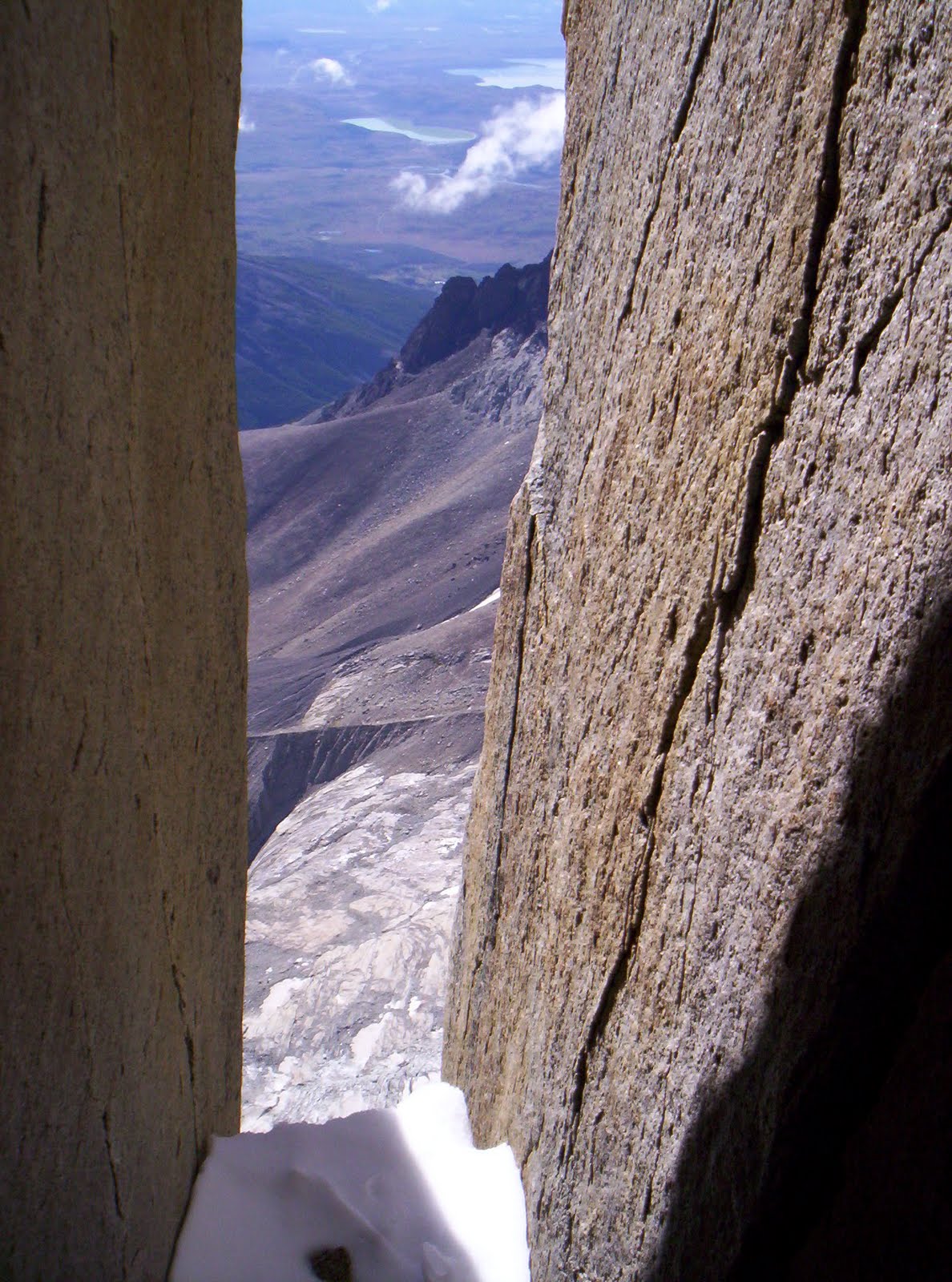
I knew I was going to see an incredible view when I reached the col and wondered what it'd look like. My mind reeled when I finally got there. While the west face is sheer for 2000' on top of the talus slope and moraine, the East face lords 8000' over the valley below. At the col I could look 7000' almost straight down. The glacier below glittered in the sun, and everything took on a blue aura, like the scenery as viewed from an airplane.

The fatigue of being on the move for 7 hours and being focused for six pitches without pause began to set in as I brought Dave up to my position. "How do you feel?" I asked Dave. "Ready to climb," he replied with enthusiasm. I was glad Dave's energy could pick up where mine left off, but I regretted that I would miss leading the next two pitches, which were the route's most difficult and interesting. No matter. There would be plenty more challenges on the route.

Even on such a calm day, the adjacent towers squeezed and concentrated the slightest breeze. I watched in wonder as Dave climbed amid a frigid gale and my hands and toes went completely numb. I donned my puffy belay jacket and ran in place to maintain circulation to my extremities.

Firs, Dave negotiated a right facing dihedral with jagged edges, which he leaned against to create counter-pressure for foot smears. Then he led the second pitch through some thin face climbing, to a short fist crack in a smooth right facing dihedral to a ledge.

When following, I had to stop repeatedly to warm my hands on the back of my neck. Dave was basking in the sun with his shoes off and a smile on his face as I reached the top.

"Nice work!" I congratulated.

"Thanks, you ready to do some more leading?" he asked. And with that I took the rack and we raced through six more pitches of blocky granite.

As I approached the summit I could see several boulders, but couldn't make out which one was the highest. Closer, I could see that one was about 40' higher than the others, but it appeared to be featureless. The words of the Dutch echoed in my mind, "The summit pitch is not scary." Well then, I must be at the top of the route, I said to myself atop the second highest boulder. The taller boulder looked terrifying.


"Gobsmacking" was the word that came to mind of the view from the top. There was a slight breeze in the warm light and I could see sharp, snow capped peaks all along our view to the west. Behind the peaks, along the horizon, was a wall of white clouds and glacier that extended out of sight, clear to the ocean. It was imposing to see such forbidding and blank territory. To the east, the grounds calmed to an expanse of flat green land as far as the eye could see. To the south was the central tower, whose top seemed a stone's throw away, and sides invoked the feeling of a skyscraper across the street.

When Dave came up, we took our summit photos and had a snack of salami, cheese and some chocolate. That higher boulder nagged me.

"Damn it," I said to Dave, "let's go get a closer look at that thing."

About then a team of three from Spain, whom we noticed below us a few pitches back, arrived. "The summit!," they exclaimed and started taking pictures atop the boulder Dave and I had just vacated. I pointed to the taller boulder 20 meters over and they said we had reached the end of the Monzino Route and that the higher boulder didn't appear climbable.

I was relieved, but now we had a long descent before us, which would be full of unknowns and potential for catastrophe. The Spaniards, David, Barbara and Pedro offered to join forces for the descent. We were thankful and agreed.

The Spaniards, especially Pedro, were very experienced and efficiently set our rappels as we leap-frogged down the mountain. The strength of our numbers made the descent a more relaxed process than it would have been and we touched down to the talus slope just as the light was waning, around 9:30pm.

Dave and I parted with the Spaniards and took a break before our epic slog home. We nibbled on some food, relieved ourselves and began the downward trek home. Intellectually, I was happy that we had succeeded in our wild goal. Just the day before I was cast in a funk because the end of our food was in sight, and Dave's knee threatened to put the trip on hold, and now we had done it! But, truly, the emotion of accomplishment failed to register. Instead, my outset plunged to my level of exhaustion.

For over two hours we picked our way down the talus and for another two hours we stumbled by headlamp back to camp. We reached camp at 1:15am, a little over 22 hours after we had departed. We cast off our gear, took off our shoes from swollen feet and moaned and grunted as we prepared to sleep. We brewed up a quick Ramen noodle soup, downed it and crawled into our tent, ready for coma. Just as we closed our eyes my watch alarm went off, set for 2am from the morning before. 24 hours. What a day!